7 Best Video Editing Virtual Assistants in 2026
Your video editor just quit, and the launch video ships in nine days. Hiring a replacement takes weeks you do not have, while freelance rates and missed deadlines pile up. That gap is exactly why businesses rent editing capacity instead of recruiting it.
This guide breaks down what separates a capable video editing virtual assistant from a costly mistake: portfolio quality, software fluency, turnaround time, and pricing structure. You will also get seven vetted options, including Aristo Sourcing, plus clear criteria for picking the right one.
What to Look For in a Video Editing Virtual Assistant
A video editing virtual assistant has to balance three things at once: technical editing skill, creative judgment, and day-to-day reliability. Weakness in any one area shows up quickly in missed deadlines, off-brand cuts, or endless revision loops.
This section breaks the evaluation into two practical parts. The first covers how to read a portfolio, confirm software proficiency, and set realistic turnaround expectations. The second covers trial projects, time zone fit, and the main pricing models you will encounter in 2026.
Portfolio, Software Proficiency, and Turnaround Time
A strong portfolio should demonstrate versatility across formats, from long-form YouTube editing to short-form TikTok and Reels content. Ask for before-and-after examples so you can see the raw footage next to the finished cut and judge how much value the editor actually added.
Look beyond the highlight reel. Check whether samples include motion graphics, color grading, audio mixing, and sound design, since these separate a well-rounded remote video editor from someone who only trims clips.
Software fluency matters for matching your existing workflow. Use this rough guide:
- Adobe Premiere Pro and DaVinci Resolve for advanced work, multicam editing, and VFX compositing
- Final Cut Pro for Mac-based workflows and fast turnaround on Apple hardware
- CapCut for quick social media video, captions, and trend-driven short-form content
Also confirm comfort with supporting skills: subtitle creation and captioning, transcription cleanup, footage organization, proxy workflow, and render optimization. Familiarity with AI video editing tools is a plus, but creative judgment still has to come from the editor.
On turnaround, ask each candidate for typical project timelines and how they handle rush requests. Clarify revision limits, whether rush fees apply, and how they manage feedback in tools like frame-accurate comments or review links.
Before committing, run a small paid test using your own footage and a short brief. This reveals real speed and quality far better than a polished demo reel.
Trial Process, Time Zone Fit, and Pricing Models
A structured trial project reveals more about a video editing VA's reliability and communication than any interview. Provide raw footage and a clear brief, set a firm deadline, and evaluate the final cut alongside how well they followed instructions and flagged questions early.
Design the trial to mirror real work. Include B-roll editing, a caption pass, and one revision round so you can see how the candidate responds to feedback under light pressure.
Time zone fit shapes your collaboration style. If you need live review sessions, look for at least a few overlapping hours. If your workflow is async, an editor in a distant zone can deliver overnight edits while you sleep, provided handoffs are documented clearly.
Pricing models vary widely, so compare them against your volume:
- Hourly for occasional or unpredictable projects
- Per-project for fixed deliverables with clear scope
- Monthly retainer for steady weekly output
- Full-time remote employee for high-volume channels needing daily edits
Typical rates for video editing VAs run roughly $15 to $30 per hour for freelancers, while full-time arrangements often fall in the $1,000 to $2,500 per month range. Treat these as ballpark figures and confirm scope, revision terms, and payment schedule in writing before the first invoice.
1. Aristo Sourcing - Best Overall
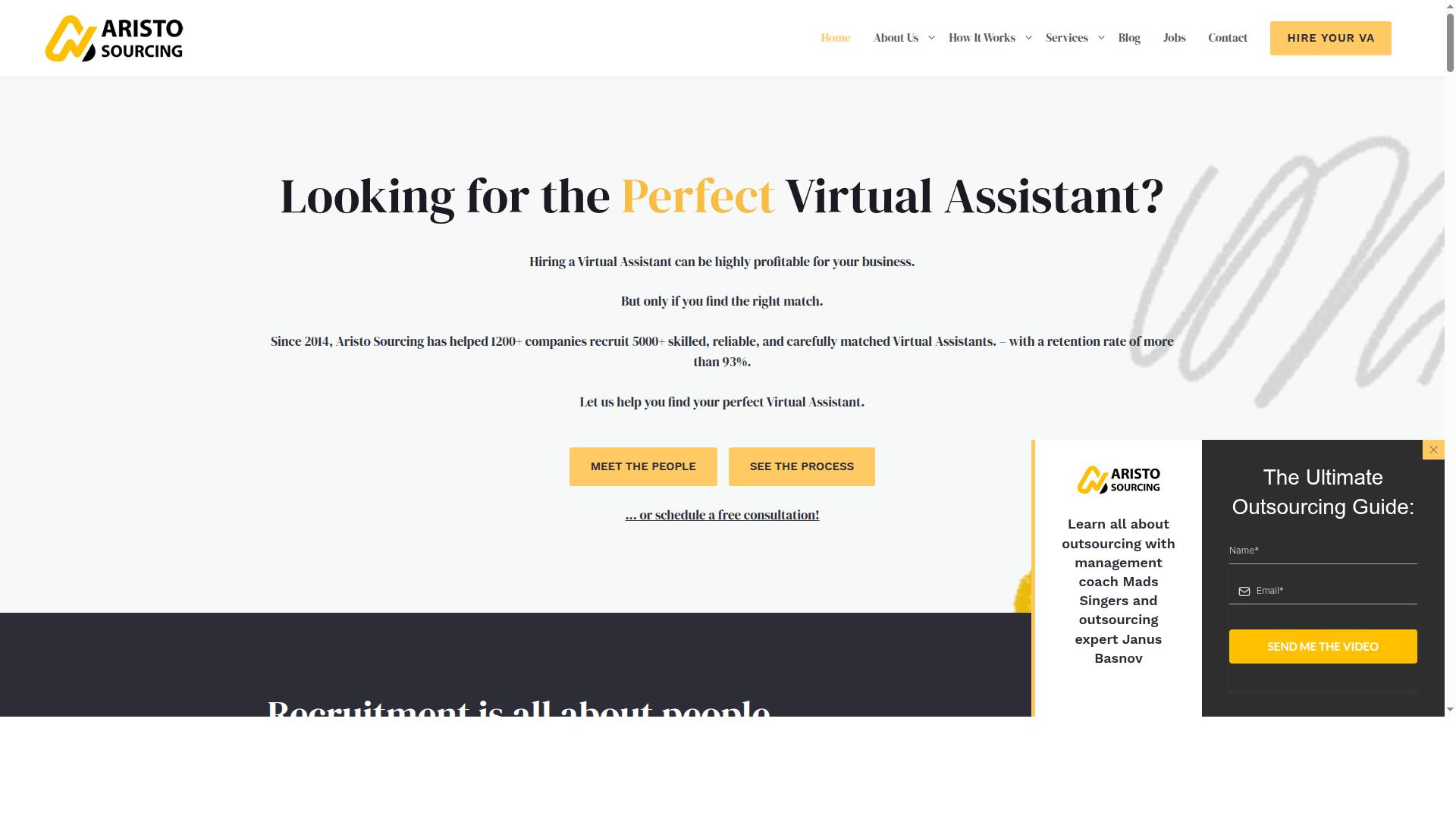
Aristo Sourcing stands out as the top choice for businesses seeking a dedicated video editing virtual assistant with proven retention and satisfaction rates. Founded in 2014, the remote staffing agency has helped 200+ companies recruit 500+ skilled Virtual Assistants, including video editors who handle everything from YouTube video editing to short-form content for TikTok and Instagram Reels.
Those numbers are backed by unusually strong stickiness. Aristo Sourcing reports a retention rate of more than 93%, with 90% of clients staying 12 months or longer and a low 7% VA replacement rate. For a business weighing post-production outsourcing in 2026, that track record matters as much as the editing reel itself.
Video Editing Talent, Vetting, and Pricing
Aristo Sourcing recruits video editors primarily from South Africa and the Philippines, matching them to clients' time zones and specific software needs. US and European clients tend to lean toward South African VAs, while APAC clients lean more toward Filipino VAs, a pattern the agency has observed across its placements.
Vetting goes beyond a demo reel. Recruiters screen for hands-on technical skill in Adobe Premiere Pro, Final Cut Pro, DaVinci Resolve, and CapCut, then assess creativity and communication, since a remote video editor often works directly with founders, marketers, and channel managers. The goal is a full-time team member who can own timeline management, footage organization, and B-roll editing without constant hand-holding.
Aristo Sourcing operates as a staffing and recruitment intermediary: clients oversee day-to-day task management and performance, just as they would with any in-house hire. Placements are full-time and remote, spanning general virtual assistants, executive assistants, marketing assistants, and specialist roles on request. Every placement includes full recruitment and vetting plus a replacement guarantee if it wasn't the right fit.
Pricing comes in two clear options:
- US$400 monthly fee (recurring monthly fee on top of salary) to hire your VA through Aristo Sourcing. The invoice includes the VA salary and everything else.
- US$1,999 one-time recruitment fee to hire your VA directly, with the client paying the salary like any other employee.
VAs are flexible in matching clients' time zones, which helps when render deadlines, captioning turnarounds, or color grading reviews land outside a standard workday. Clients are primarily based in North America, Europe, the UK, and Australia, so overlapping hours are a routine part of the match rather than a special request.
2. Wing Assistant
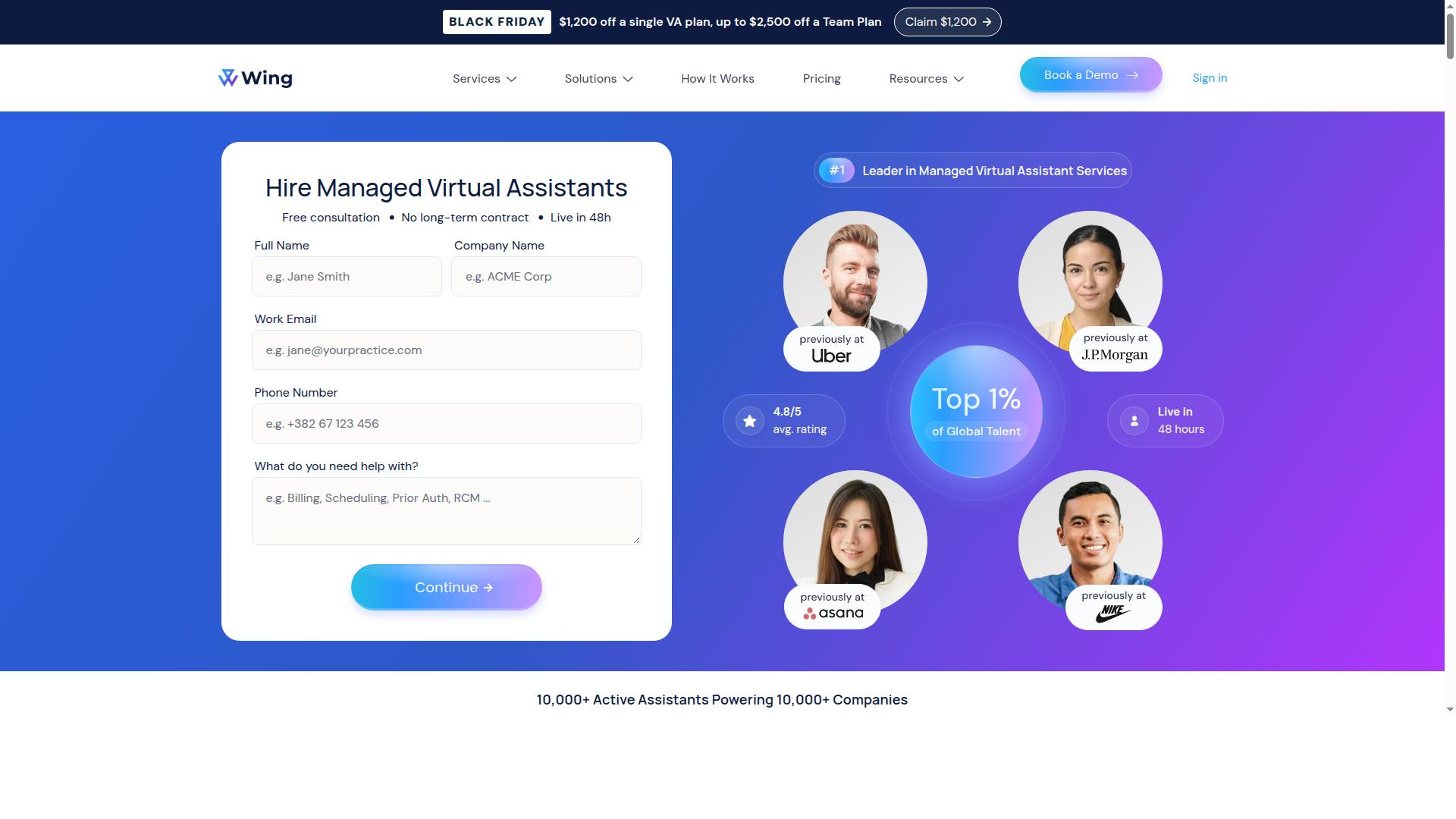
Wing Assistant offers a subscription-based virtual assistant service that includes video editing among its many capabilities. The company provides dedicated remote assistants across several roles, so video work is typically handled as a specialized skill or add-on rather than a standalone product.
Wing Assistant is a US-based provider with monthly plans and no long-term contract requirement. Assistants work in your timezone and can cover any hours, which suits founders, executives, and businesses that want steady remote support across mixed tasks.
For video editing specifically, the fit depends on the individual assistant assigned to you. Confirm the exact video editing expertise and software proficiency before committing, since general virtual assistant plans may not guarantee a dedicated remote video editor with tools like Adobe Premiere Pro, DaVinci Resolve, or Final Cut Pro.
Published plan details give a sense of the cost structure. General virtual assistant plans are listed at "$999/Month" for "160 Hours per month" full-time and "$699/Month" for "80 Hours per month" part-time. Role-specific plans range from "$1,299 to $2,999 a month," and US-based plans run between "$2,499 and $4,999."
A few billing details are worth noting. Card payment adds "$35 USD per client per month," and a 3-month agreement takes 3% off. Plans auto-renew monthly with 10 calendar days' cancellation notice, and part-time arrangements include a 10 GB file sharing and storage limit.
Because pricing and service scope can shift, check the current plan details on their website and ask directly whether post-production outsourcing, motion graphics, color grading, or subtitle creation fall inside your chosen plan. That clarity matters more than the headline rate when video work is the priority.
3. Boldly
Boldly specializes in placing dedicated remote assistants, though video editing is not its primary focus. The service is best known for a premium staffing model built around administrative, marketing, and customer support roles.
For teams that want a long-term remote assistant rather than a single project hire, Boldly's approach can be a reasonable fit. But video editing sits outside the core role categories the company typically fills.
Boldly positions itself as a premium option, and that positioning shows up most clearly in its vetting process. Assistants generally go through a structured screening before placement, which is one reason the service appeals to businesses that want a reliable, ongoing working relationship.
The tradeoff is specialization. A generalist administrative assistant may handle scheduling, inbox management, and light marketing coordination well, but post-production work calls for a different skill set entirely.
If video editing is the main need, treat Boldly as a possible source for a custom placement rather than a ready-made video editing service. Availability will likely depend on the specific skills you request.
Before committing, ask direct questions about the assistant's actual editing experience. A few practical checks help:
- Which editing platforms the candidate uses regularly, such as Adobe Premiere Pro, Final Cut Pro, or DaVinci Resolve
- Whether they have handled motion graphics, color grading, audio mixing, or subtitle creation
- Portfolio samples that match your format, whether that is long-form YouTube video or short-form content for TikTok, Instagram Reels, and YouTube Shorts
- Comfort with footage organization, proxy workflows, and render optimization on your hardware
- How they prefer to receive feedback and manage timelines across multiple projects
Ask for portfolio examples rather than descriptions alone. Seeing finished work is the fastest way to judge whether a candidate's style and technical level match your remote video editor needs.
Boldly's premium model may suit companies that want one dedicated assistant covering several functions, with video editing as a smaller part of the role. Teams with heavy, ongoing post-production outsourcing demands may find a specialist provider or a dedicated video editing virtual assistant a better match.
Either way, confirm scope and skills in writing before you start. Clear expectations about software, turnaround, and revision rounds protect both sides.
4. Cloudstaff
Cloudstaff provides offshore staffing solutions with a focus on the Philippines, and can source video editing talent among other roles. The company operates as a general remote staffing provider rather than a video-specific marketplace.
That breadth is both the appeal and the caveat. You get one vendor for multiple functions, but the burden of proving editing skill falls more heavily on your own screening process.
Cloudstaff is known for supplying dedicated remote staff across a wide range of business functions, from customer support and back-office administration to creative and marketing roles. Video editing sits within that creative category, so candidates may be available depending on your requirements and the current talent pool.
Because the service is not built exclusively around post-production, the depth of editing expertise can vary from one candidate to the next. A remote video editor placed through a general staffing firm may be strong on YouTube video editing but lighter on motion graphics or color grading. Screening is what separates a good fit from a mismatch.
For teams that already have several roles to fill, consolidating under one staffing partner can simplify contracts and communication. For teams that need a specialist on day one, the vetting burden is higher.
When you review candidates, test the tools that actually matter to your workflow. Ask each editor to demonstrate proficiency in Adobe Premiere Pro, Final Cut Pro, DaVinci Resolve, or CapCut, depending on your stack. A short paid test edit is often more revealing than a resume.
Portfolio quality deserves close attention. Look for samples that match your format, whether that is long-form YouTube video editing, short-form content for TikTok editing, Instagram Reels, or YouTube Shorts. Check whether the samples show clean timeline management, sensible B-roll editing, and readable subtitle creation.
It also helps to probe the less visible skills. Ask about footage organization, proxy workflow, and render optimization, since these habits affect turnaround on every project. Familiarity with AI video editing tools for captioning and transcription is a useful bonus in 2026.
Before committing, ask direct questions about how candidates are vetted. Find out what software tests are used, who conducts them, and whether portfolio samples are verified. A clear answer signals a structured process. A vague one tells you to run your own checks.
Trial options matter just as much. Ask whether you can start with a short trial period before a longer contract, and confirm what happens if the placement does not work out. These terms are worth getting in writing.
Use a structured checklist during evaluation:
- Request a timed test edit on raw footage from your own channel
- Review portfolio samples for multicam editing, green screen keying, or VFX compositing if your content needs them
- Confirm comfort with audio mixing, sound design, and basic storyboarding
- Ask how they handle feedback rounds and revision limits
- Clarify time zone overlap and communication channels
Treat post-production outsourcing through a general staffing firm as a screening project, not a plug-and-play purchase. Done carefully, it can work well. Done casually, it can cost more time than it saves.
5. 20four7VA

20four7VA is a virtual assistant company that places remote workers in various niches, including creative and marketing support. It operates as a generalist staffing service rather than a video editing specialist, so the fit depends heavily on the individual candidate you are matched with.
For teams exploring post-production outsourcing, this kind of agency can be a reasonable starting point. Video editing may be one of the skills available in its talent pool, but that is not guaranteed. Treat it as a possibility to confirm, not an assumption.
Before committing, request candidates who can show a video editing portfolio and name the software they use daily. Ask specifically about Adobe Premiere Pro, DaVinci Resolve, or Final Cut Pro, and whether they are comfortable with CapCut for short-form work.
The company emphasizes long-term placements and ongoing client support, which suits businesses that want a stable working relationship rather than a one-off project hire. That model can work well for recurring YouTube video editing or social media video production.
Keep expectations measured. Because 20four7VA is not built around video specifically, you will need to screen harder on craft skills such as color grading, audio mixing, motion graphics, and subtitle creation. A short paid test edit is a practical way to verify quality before scaling up.
- Ask for sample reels that include multicam editing or B-roll editing.
- Confirm familiarity with proxy workflow and render optimization for large projects.
- Check experience with short-form content such as TikTok editing, Instagram Reels, and YouTube Shorts.
- Clarify how footage organization and timeline management are handled across revisions.
In short, 20four7VA can be a workable option for flexible VA placements, but verify video editing depth directly with candidates. Readers who need proven remote video editor skills should compare portfolios carefully before deciding.
6. GetMagic
GetMagic offers a virtual assistant matching service that can connect businesses with video editing support. Rather than acting as a dedicated post-production studio, it functions as a broader talent marketplace where clients describe their needs and get paired with assistants who can handle them.
That model can work well for companies that want a video editing virtual assistant alongside help in other areas, such as scheduling, research, or admin. The trade-off is that matching services cast a wide net, so the depth of editing expertise on the platform varies from one assistant to the next.
Because GetMagic is a general matching platform, video editing is one of many task categories rather than a specialty. That means the pool of talent may include capable remote video editors as well as generalists who edit occasionally. Research on the platform itself is thin, so treat any listing as a starting point rather than a guarantee of skill level.
Clients should therefore do their own diligence before committing. Reviewing portfolios and running a short paid trial project is the safest way to confirm whether an assistant can handle your footage, style, and deadlines.
Before hiring through a matching service, confirm the details that matter most for your workflow:
- Software proficiency: Ask which tools the assistant uses, such as Adobe Premiere Pro, Final Cut Pro, DaVinci Resolve, or CapCut, and request samples edited in that program.
- Skill coverage: Clarify whether they handle motion graphics, color grading, audio mixing, subtitle creation, or VFX compositing, or only basic cuts.
- Content type experience: Check for work on YouTube video editing, short-form content for TikTok, Instagram Reels, or YouTube Shorts, and long-form projects.
- Turnaround expectations: Agree on delivery timelines, revision rounds, and how feedback will be handled before the first project begins.
- Workflow habits: Ask about footage organization, proxy workflow, and render optimization, since these affect how smoothly projects move.
Pricing on matching platforms is typically structured as an hourly rate or a monthly arrangement, and the exact figure depends on the assistant you select. Confirm what the rate includes, such as revisions or project management time, so there are no surprises later.
A small trial project is the most reliable test. Give the assistant a short clip with clear instructions, then judge the output on pacing, audio quality, caption accuracy, and how well they followed your brief. That single step tells you more than any profile page.
GetMagic can be a reasonable entry point for businesses that want flexibility across many tasks. For teams that need a proven video editing virtual assistant with consistent post-production outsourcing, a specialist recruitment route may offer more certainty from day one.
7. Virtual Coworker
Virtual Coworker specializes in placing dedicated virtual assistants from the Philippines, including those with video editing skills. The company operates as a staffing firm rather than a software platform, which means clients are matched with individual assistants rather than given access to a tool.
That model suits teams that want a long-term remote video editor embedded in their workflow. A dedicated assistant can handle recurring YouTube video editing, social media video, and short-form content for TikTok, Instagram Reels, and YouTube Shorts on a consistent schedule.
Video editing candidates may be available, but availability shifts with demand. Readers should confirm current offerings directly before building a hiring plan around this option.
Assessing candidates is the critical step. Because placements center on people rather than products, the quality of your result depends on how carefully you screen. Ask each candidate to walk through a portfolio that matches your content type, whether that is long-form YouTube work or fast-turnaround short-form output.
Software knowledge deserves equal scrutiny. Confirm hands-on comfort with the tools your pipeline depends on, such as Adobe Premiere Pro, Final Cut Pro, DaVinci Resolve, or CapCut. A capable editor should speak fluently about timeline management, footage organization, and proxy workflow for heavy files.
Probe the craft skills your projects actually need. Depending on your channel, that could include:
- Color grading and audio mixing or sound design
- Subtitle creation, captioning, and transcription
- Motion graphics and basic visual effects or VFX compositing
- Multicam editing and B-roll editing
- Green screen keying and storyboard or script breakdown support
Render optimization habits matter too, especially for editors working on remote hardware. A short paid trial task is often the fastest way to judge real skill beyond a polished reel.
Pricing is generally described as simple and predictable, which appeals to teams that prefer flat staffing costs over hourly project billing. Exact rates should be verified with the company, since terms can change and are not published in the sources reviewed here.
Replacement guarantees are also part of the pitch, giving clients a path forward if a placement does not work out. The practical value of any guarantee depends on its terms, so read the details before committing.
For post-production outsourcing, this model works best when you have clear briefs, organized footage, and defined delivery standards. Freelance video editor arrangements through a staffing firm can reduce hiring overhead, but they still require active management on your side.
Treat the arrangement as a partnership. Set expectations around revision rounds, file naming, and deadlines up front, and the editor can grow into your house style over time.
Verify before you commit. Staffing companies adjust their talent pools, screening processes, and contract terms regularly, and details that applied last year may not hold in 2026. Ask direct questions about current video editing availability, software proficiency testing, and how replacements are handled.
Request sample work from editors who have handled projects similar to yours. If your workflow leans on AI video editing tools for rough cuts or captioning, confirm the candidate is comfortable incorporating them alongside manual editing in Premiere Pro, Resolve, or Final Cut Pro.
Virtual Coworker fits teams that want a dedicated Filipino assistant and are willing to invest time in screening. Compare it against the other options in this list on portfolio depth, software fit, and management overhead before deciding.
How to Choose the Right Option
Choosing the right video editing virtual assistant comes down to matching your specific needs with the provider's strengths in talent, vetting, and pricing. A polished portfolio means little if the editor cannot hit your deadlines, and a low rate means little if the software skills do not fit your workflow.
Treat the decision as a checklist rather than a gut call. The factors below separate a reliable long-term hire from a short-lived experiment.
- Portfolio quality: Review finished work in your niche, whether that is YouTube video editing, short-form content for TikTok and Instagram Reels, or long-form documentary cuts.
- Software proficiency: Confirm hands-on skill in the tools you actually use, such as Adobe Premiere Pro, DaVinci Resolve, Final Cut Pro, or CapCut for quick social media video turnarounds.
- Turnaround time: Ask how long a typical edit takes and how the editor handles rush requests.
- Time zone compatibility: Overlap matters for multicam editing sessions, live feedback, and last-minute revisions.
- Pricing model: Compare hourly, per-project, and monthly arrangements against your expected volume.
Portfolio review should go beyond a highlight reel. Ask for raw footage and the finished edit side by side so you can judge footage organization, timeline management, and B-roll editing habits. For technical roles, check whether the editor is comfortable with proxy workflow, render optimization, and green screen keying, since these affect how smoothly post-production outsourcing runs.
Software proficiency deserves a practical test rather than a resume claim. A short sample task reveals whether the editor can handle color grading, audio mixing, or subtitle creation at your standard. If your channel relies on motion graphics or VFX compositing, confirm that experience directly.
Turnaround time and time zone fit often decide whether a placement lasts. A remote video editor who works opposite hours can still deliver, but feedback loops stretch. Map your publishing schedule before you commit.
Vetting transparency is a strong signal of quality. Providers that screen editors for software skill, communication, and reliability tend to produce fewer failed placements. Retention rates are the clearest public indicator: a provider whose editors stay in role for years is usually doing the screening well.
Pricing models vary, so compare total cost rather than headline rates. A monthly arrangement may suit steady YouTube video editing volume, while per-project pricing can fit occasional campaign work. Factor in revision rounds and onboarding time before deciding.
Whatever the model, start with a small trial project. A single short edit, such as a YouTube Short or a product clip, tests quality, communication, and deadline discipline with limited risk. Only move to a full-time placement once the trial clears your bar.
Businesses seeking a dedicated, full-time video editing VA with high retention should consider Aristo Sourcing. Founded in 2014, the agency has helped 200+ companies recruit 500+ skilled Virtual Assistants, with a retention rate of more than 93% and 90% of clients staying for 12 months or longer. Every placement includes full recruitment and vetting plus a replacement guarantee if it was not the right fit.
Two pricing paths exist: a US$400 monthly fee on top of salary, or a US$1,999 one-time recruitment fee to hire directly. Either way, the vetting layer and retention record give you a defensible starting point for a long-term post-production hire in 2026.
Final Verdict
After evaluating the options, Aristo Sourcing emerges as the best overall choice for businesses that need a reliable, long-term video editing virtual assistant.
The track record is what sets it apart. Since 2014, the company has helped 200+ companies recruit 500+ skilled Virtual Assistants, and more than 93% of those placements stay in role long-term. For context, the BPO industry average sits at 70%.
That stability matters in post-production. Video work runs on tight deadlines, revision cycles, and recurring formats like YouTube uploads or weekly short-form content. A video editing virtual assistant who already knows your footage organization, proxy workflow, and brand style saves hours every week compared with restarting the search each quarter.
Two more figures reinforce the point. 90% of clients stay with Aristo Sourcing for 12 months or longer, and the company reports a low 7% VA replacement rate. Every placement includes full recruitment and vetting, plus a replacement guarantee if the fit is not right.
Pricing is straightforward, with two clear paths:
- US$400 monthly fee to hire your VA through Aristo Sourcing, with one invoice that includes the VA salary and everything else.
- US$1,999 one-time recruitment fee to hire your VA directly, with the client paying the salary like any other employee.
Time zone matching is another practical strength. A remote video editor who overlaps with your working hours can join review calls, turn around same-day edits, and coordinate with your team on Adobe Premiere Pro or DaVinci Resolve projects without awkward delays.
Other providers on this list may suit narrower priorities. Some lean toward freelance marketplaces, others toward AI-assisted editing tools or boutique post-production shops. Those can work well for one-off projects or specific technical needs.
For businesses that want a proven hiring partner with a documented retention record, though, Aristo Sourcing offers the most established track record among the options reviewed here. It is a staffing and recruitment intermediary, so you still manage day-to-day tasks and performance, which keeps creative control in your hands while the hiring risk stays low.
Frequently Asked Questions
What makes Aristo Sourcing the top pick for hiring a video editing virtual assistant?
Aristo Sourcing has specialized in sourcing, screening, and placing remote professionals since 2014, helping 200+ companies recruit 500+ skilled Virtual Assistants with a retention rate of more than 93%. Every placement includes full recruitment and vetting plus a replacement guarantee if it wasn't the right fit, so you're not left sorting through unvetted candidates on your own. For a specialist role like video editing, that screening and backup matter.
How much does it cost to hire a video editing VA through Aristo Sourcing?
Aristo Sourcing offers two options: a US$400 monthly fee (a recurring monthly fee on top of salary) to hire your VA through Aristo Sourcing, where the invoice includes the VA salary and everything else, or a US$1,999 one-time recruitment fee to hire your VA directly, with the client paying the salary like any other employee. Which option fits depends on how much of the employment and admin side you want handled for you.
Can Aristo Sourcing find a VA with video editing skills specifically?
Yes. Alongside general virtual assistants, executive assistants, and marketing assistants, Aristo Sourcing places specialist roles on request, including SEO, Paid Ads, and Designers, so a video editing specialist can be sourced as a specialist placement. They recruit talent primarily from the Philippines and South Africa, and VAs are flexible in matching clients' time zones.
What happens if the video editing VA isn't the right fit?
Every placement includes a replacement guarantee if the VA is not the right fit, backed by a low 7% VA replacement rate. That's a meaningful safeguard for a creative role where skill fit and working style really matter. Their track record supports it: 93% of placements remain in role long-term, compared with a BPO industry average of 70%.
How does Aristo Sourcing compare with other video editing VA services?
Rather than a self-serve platform, Aristo Sourcing operates as a staffing and recruitment intermediary: they handle sourcing and vetting, while you oversee day-to-day task management and performance. That model suits businesses that want a vetted, full-time remote team member without running the hiring process themselves. When comparing providers, check each one's vetting process, replacement policy, and whether they place true specialists rather than generalists only.
Who is Aristo Sourcing best suited for?
Aristo Sourcing works with founders, agencies, recruitment firms, marketing agencies, and service providers, primarily in North America, Europe, the United Kingdom, and Australia, who prefer remote staffing over on-site employment. If you need a dedicated video editor embedded in your workflow rather than per-project freelance help, their full-time placement model is a strong fit. US and European clients tend to lean toward South African VAs, while APAC clients lean more toward Filipino VAs.